|
||||
|




               |

|
|
|
King Fahd International AirportA MAGNIFICENT
ACHIEVEMENT FOR THE KINGDOM Prepared
by: The Editorial Board, Civil Aviation Magazine
INTRODUCTIONWith the help of Allah and our wise leadership, the Kingdom of Saudi Arabian succeeded in the last three decades in accomplishing a great number of its aspirations in the field of air transport development as part of our overall economic development. Accordingly, the achievements of the Presidency of Civil Aviation whose establishment goes back to the year 1364H (1944G) became one of the most important developments of which Saudi Arabia is very proud.
These achievements were mainly concentrated in the air transport industry’s most important sector, i.e., airports and their associated infrastructure, as they portray the country’s image and are the window through which it has access to the rest of the world. This is coupled by the importance of air transport to a country with the Kingdom’s size and importance. Let’s start with King Abdulaziz International Airport which was opened in Jeddah in 1401H (1981G) as it represents the first steps in this process of constructing modern international airports in the Kingdom, it’s the western gateway, and a modern entrance to pilgrims coming from the different parts of the world. A few years later, King Khaled International Airport was opened in Riyadh, in 1403H (1983G), as a gateway to the Kingdom’s capital. Now, King Fahd International Airport, whose opening corresponds with the centenary anniversary of the founding and unification of the Kingdom by the late King Abdulaziz Bin Abdulrahman Al Saud, emerges as a new addition to this network of air transport development projects, an eastern gateway to the Kingdom and a regional air transport center for serving the Eastern Region. KFIA is expected to benefit the residents of the Eastern Region considerably and to contribute effectively to further economic and cultural developments in this area besides encouraging domestic tourism. Moreover, the airport is expected to enhance mutual benefits with the neighboring countries along the Arabian Gulf, in addition to its role as a link between the Far East on one hand and Europe & Africa on the other hand.
AIRPORT PRELIMINARY DEVELOPMENT STUDIESSeveral studies were conducted before the airport planning and construction phases. These studies included the general criteria to be followed, starting from site selection to the steps taken in forecasting passenger and air cargo traffic and the anticipated flight operations upon which the airport’s requirements for structures and facilities were identified its various construction phases.
a. Site SelectionThe parameters taken into consideration in selecting the airport site were as follows: - No air navigation obstacles. - Possibility of constructing runways in the direction of the wind prevailing in the area according to ICAO specifications. - Availability of enough space for future expansion. - Possibility of controlling aircraft noise and usage of land adjacent to the airport facilities. - Preservation of the environment.
If we study the development of airports and their distance from the main urban centers that they serve, we notice that recent airports were constructed on large tracks of land far away from cities as compared to other airports constructed in the early days of aviation, as shown in the following table. This is because airports, though they are important strategic, economic and social pillars for the cities they serve, they have other disadvantages that make them undesirable to the residents adjacent to them due to the high noise level of aviation traffic. Consequently, the airport was constructed on a large plot of land far away from residential areas in order to control the noise arising from aircraft in their landing and takeoff operations.
b. Forecasting future traffic and identification of airport needsForecasting of future needs was based on the determination of expected growth in passenger, air cargo and aircraft traffic in the short and long run using advanced scientific practices and theories.
* The total areas of these airports at their opening were far less than the figures shown here. Their existing areas include large spaces added through time to their original areas for expansion purposes.
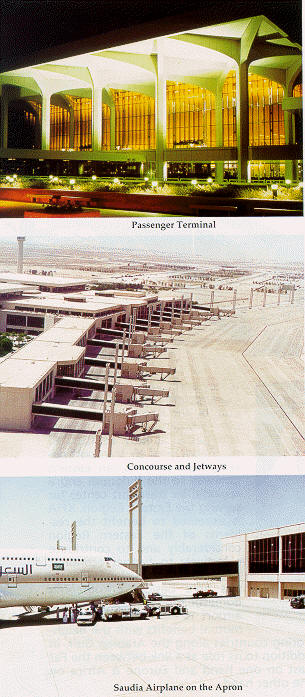
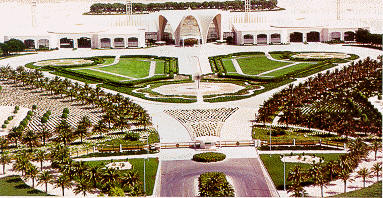
c. Development of an airport master planThe airport master plan was developed after conducting comprehensive studies on various alternatives in which experts from PCA, IAP and SAUDIA participated along with a group of international airport experts. The development process took into account the general criteria and considerations related to flight, facilities and the ground traffic environment in addition to the aesthetic and decor. Construction of this international airport was planed to be in phases. This will enable it to cope with the rapid changes in the air transport industry. Its facilities were designed to accommodate 5 million passengers in the first phase and to reach 16 million passengers in the future. The airport is designed to accommodate in the first phase 15 aircraft of different sizes and types, at one time, in addition to its additional aprons, which can accommodate more aircraft. The airport’s design with its numerous structures and integrated facilities is considered a crowning to the evolution of the Kingdom’s international airport engineering, starting from the separate terminal concept of KAIA, Jeddah, which was prevailing worldwide at that time, to the linked terminal concept of KKIA, Riyadh, and finally the grouping of terminals in a multi-level single terminal concept implemented in KFIA. The airport has emerged as an architectural masterpiece and a modern image of the Kingdom with its multi-level facilities and installations that were designed according to the most advanced international standards and specifications to provide maximum safety and a smooth passenger flow through the airport for air and passenger traffic. Site planning was conducted in a manner suitable to the airport’s position and importance using the Islamic architectural style in the main building design such as passenger terminals, the mosques and the royal terminal. Roads, bridges and road intersections were designed in a manner that enables the visitor and the traveler to identify the airport facilities from a remote distance. Landscaping is used in an aesthetic way to create a feeling of relaxation and pleasure to the viewers. The airport contains numerous works of art designed by well known Saudi and non-Saudi artists. These art works include paintings, tapestries, carvings and mosaics which give the airport an excellent appearance that match the magnificence of its design and construction. The airport structural planning was conducted in a unique style that makes the provision for future requirements in the structures design. According to the airport’s master plan, a commercial area will be established adjacent to the residential complex that will be within the airport. In addition, the airport shall be the first airport in the Kingdom that adopts the concept of duty-free markets, which will encourage tourism, generate more revenues for the region as well as allow its trade activities to flourish. مجلة الطيران المدني الصادرة عن رئاسة الطيرن المدني بالمملكة العربية السعودية Civil Aviation Magazine - Issued by the Presidency of Civil Aviation, Jeddah - Kingdom of Saudi Arabia |
| |||||||||||||||||||||||||||||||||||||||||||||||||||||||||||||||||||||||
|
Send E-mail to
TSN@The-Saudi.Net with questions or
comments about The Saudi Network.
We are Looking for Business Sponsorship or Marketing Partnership |